


Quick Answer
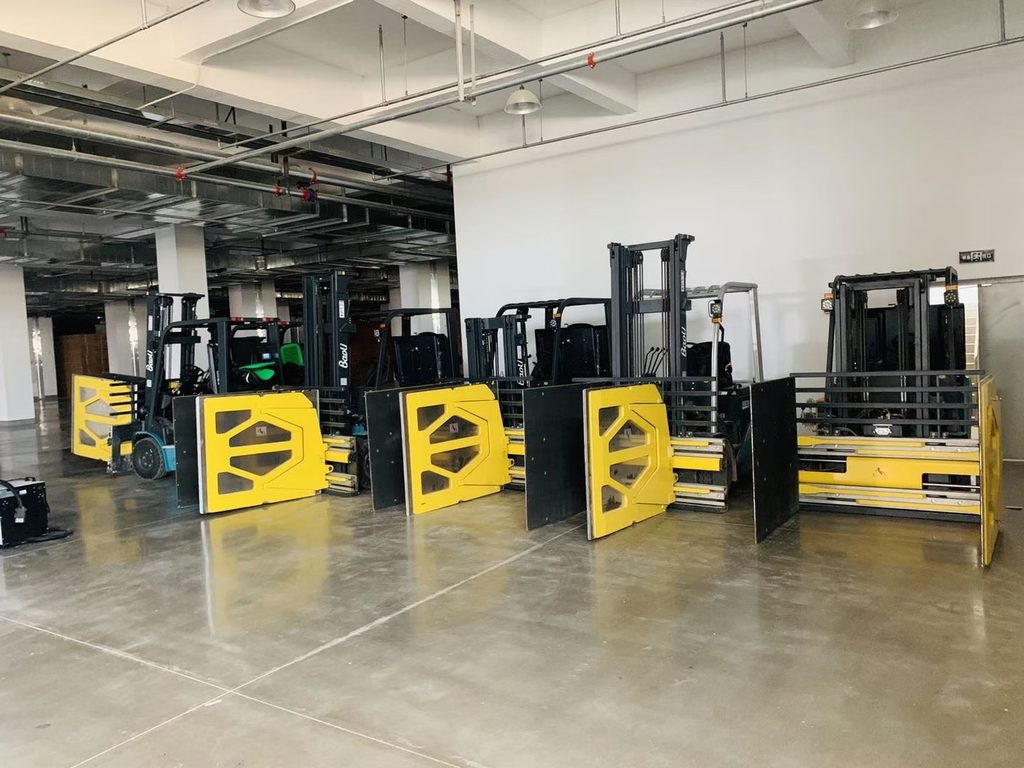
A forklift carton clamp is a hydraulic attachment designed to handle palletless carton loads by applying controlled pressure to both sides of a unit load. Unlike conventional forklift forks, which support goods from underneath, carton clamps grip the load laterally using large contact pads.
Carton clamps are commonly used for handling household appliances, consumer electronics, food and beverage products, consumer goods and other standardized cartonized loads. However, they are not suitable for every application. Carton strength, load stability, surface friction, dimensions and product fragility should be evaluated before selecting a clamp.
What Is a Forklift Carton Clamp?
A carton clamp is a specialized forklift attachment designed to lift, transport and stack cartonized goods without requiring pallets.
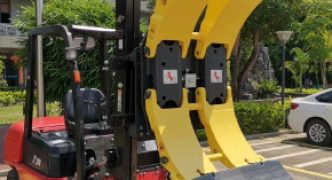
Instead of inserting forks underneath the load, the attachment uses two hydraulically controlled clamp arms to apply pressure to both sides of the load. Once the load is securely clamped, the forklift can lift and transport it as a unit.
A typical forklift carton clamp consists of:
A mounting frame
Hydraulic cylinders
Adjustable clamp arms
Sliding components
Large-area contact pads
Pressure control components
Optional sideshifting mechanisms
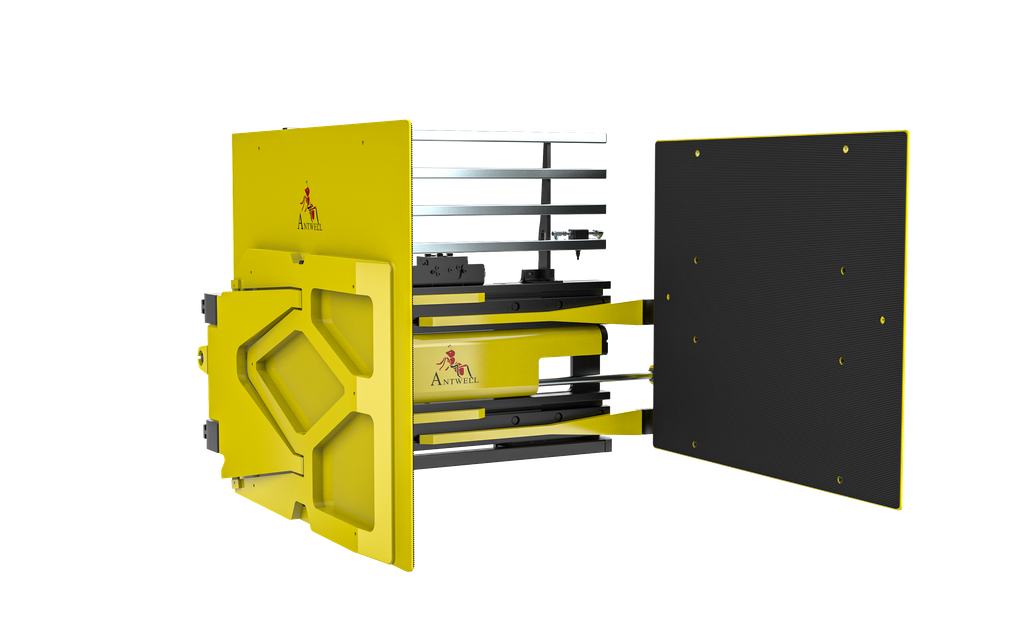
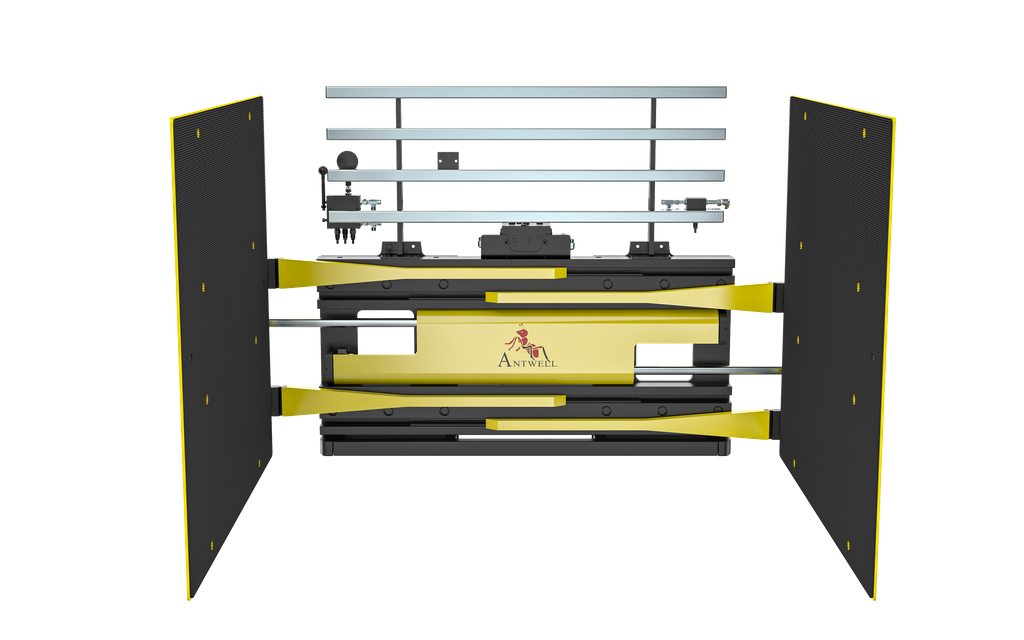
Carton clamps are commonly used in palletless material handling operations where loads have relatively consistent dimensions and sufficient structural strength.
Key takeaway: A carton clamp is designed for stable cartonized loads that can withstand controlled lateral clamping pressure during handling.
How Does a Forklift Carton Clamp Work?
A carton clamp works by using the forklift’s hydraulic system to generate controlled clamping force.
The basic handling process usually involves five steps.
1. Position the Clamp
The forklift approaches the unit load and aligns the clamp arms with both sides of the cartons.
2. Adjust the Opening Range
The clamp arms move outward or inward to match the width of the load.
3. Apply Controlled Clamping Pressure
The hydraulic cylinders move the clamp arms inward and apply pressure to both sides of the load.
4. Lift and Transport the Load
Once the load is securely stabilized, the forklift lifts and transports it to the required location.
5. Position and Release
After positioning the load, the operator releases the clamping pressure and withdraws the attachment.
The effectiveness of carton clamp handling depends on applying the correct amount of pressure.
Too little pressure may allow the load to slip. Excessive pressure may deform cartons or increase the risk of product damage.
Higher clamping pressure does not necessarily provide better load stability. The correct pressure depends on the load weight, carton strength, surface friction and product characteristics.
What Types of Loads Can Carton Clamps Handle?
Carton clamps are generally suitable for standardized unit loads with stable stacking configurations.
Typical characteristics of suitable loads include:
Consistent load dimensions
Adequate carton compression strength
Stable stacking patterns
Relatively flat contact surfaces
Sufficient surface friction
Predictable load weights
Common products handled with carton clamps include:
Refrigerators
Washing machines
Air conditioners
Televisions
Consumer electronics
Boxed beverages
Packaged food
Paper products
Household goods
Consumer packaged goods
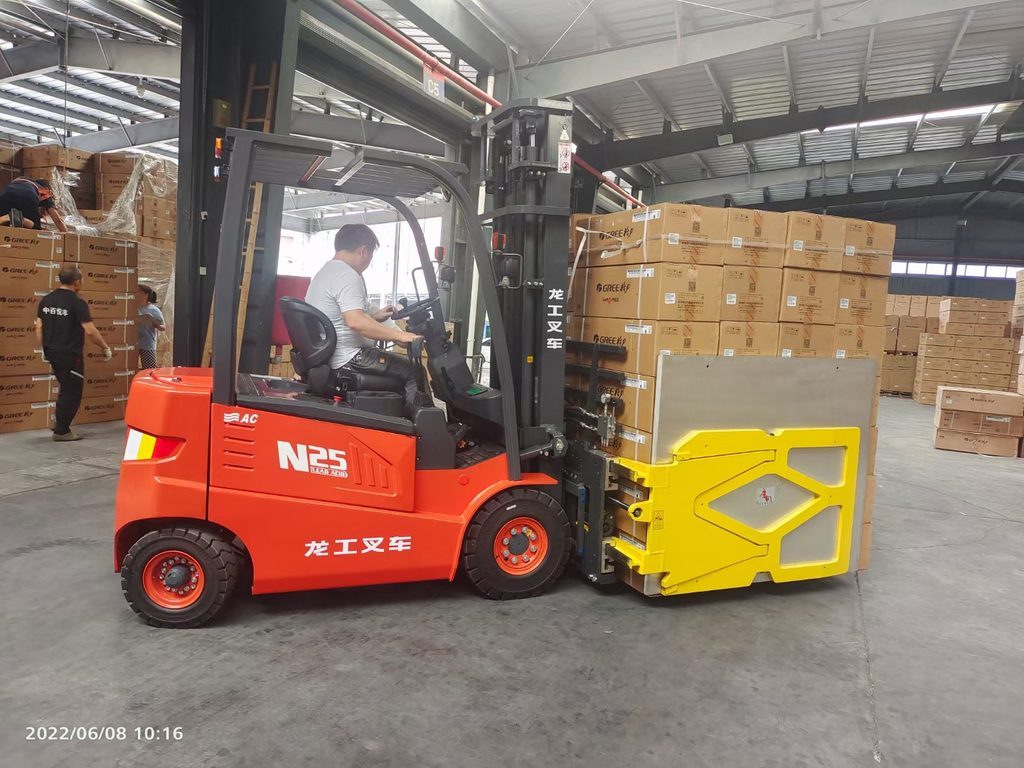
The ideal carton clamp application usually involves repetitive handling of similar loads in a warehouse, manufacturing or distribution environment.
Where Are Forklift Carton Clamps Used?
Home Appliance Industry
Carton clamps are widely used for handling packaged home appliances such as refrigerators, washing machines, dishwashers and air conditioners.
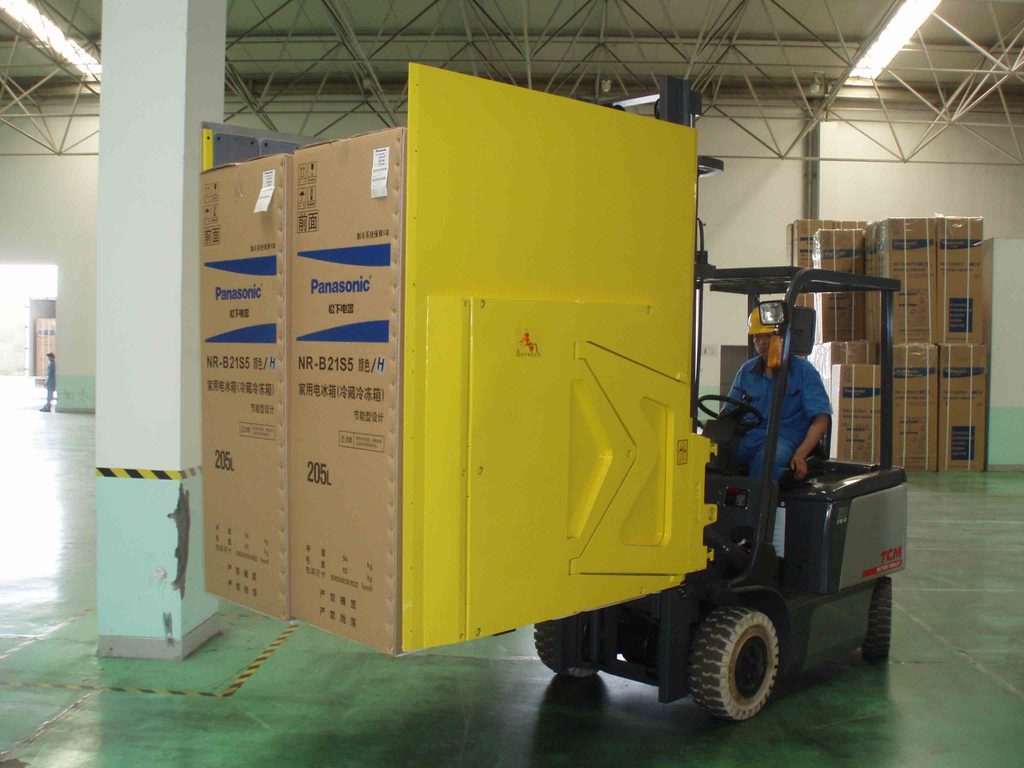
Typical handling challenge
Large appliances often require high-volume movement between production lines, warehouses and shipping areas. Conventional forks may require pallets and fork insertion underneath the load.
Why carton clamps are used
Carton clamps allow loads to be handled from the sides. Large contact pads can distribute pressure across a wider surface area when the attachment is properly configured for the packaging.
Consumer Electronics Industry
Typical applications include:
Televisions
Speakers
Smart home devices
Small household appliances
Electronic products often require careful packaging protection during transportation and warehouse handling.
Adjustable clamping pressure and suitable contact pads can help operators match the attachment to different packaging characteristics.
Food and Beverage Logistics
Carton clamps can be used to handle standardized loads of:
Boxed beverages
Packaged snacks
Dairy products
Canned goods
They are particularly suitable for high-volume operations where products have consistent packaging and palletless handling is operationally practical.
Consumer Goods and Daily Chemical Products
Typical products include:
Cosmetics
Cleaning products
Paper products
Textiles
Household products
Carton clamps can support repetitive warehouse operations involving large volumes of standardized carton loads.
Distribution Centers and Logistics Operations
Typical applications include:
Warehouse transfers
Container loading
Container unloading
Batch handling
Distribution operations
Carton clamps are often considered when a logistics operation handles consistent unit loads and wants to reduce dependence on pallets.
When Should You NOT Use a Carton Clamp?
Carton clamps are not suitable for every material handling application.
A carton clamp may not be the best choice when:
Cartons have insufficient compression strength
Loads are loosely stacked or unstable
Load dimensions vary significantly
Packaging surfaces are extremely slippery
Products have irregular external shapes
Internal products cannot tolerate lateral pressure
The unit load cannot maintain stability when clamped
A carton clamp relies on the structural integrity of both the packaging and the complete unit load.
If a load cannot safely withstand lateral clamping pressure, a carton clamp may increase the risk of carton deformation or product damage.
Before selecting a carton clamp, both the external packaging and the internal product characteristics should be evaluated.
Key Features of a Forklift Carton Clamp
The design of a carton clamp affects handling precision, load protection and operational flexibility.
| Feature | Function | Why It Matters |
| Self-lubricating sliding bars | Reduce friction during arm movement | Can help reduce wear and maintenance requirements |
| Thin clamp arms | Allow easier positioning around tightly stacked loads | Improves handling flexibility |
| T-shaped sliding components | Support structural strength and load distribution | Helps maintain operating stability |
| Sideshifting mechanism | Moves the load horizontally | Improves placement accuracy |
| Multi-stage pressure control | Provides different pressure settings | Helps match clamping force to load characteristics |
| Vulcanized rubber contact pads | Increase friction and cushion contact | Helps reduce slipping and protect carton surfaces |
| High-strength frame | Supports repeated handling cycles | Helps maintain structural rigidity |
Why Is Clamping Pressure Important?
Clamping pressure is one of the most important factors in carton handling.
Different loads require different levels of pressure.
For example, a lightweight carton containing fragile products may require lower clamping pressure than a heavier load with stronger packaging.
The required pressure can be influenced by:
Load weight
Carton compression strength
Surface friction
Product fragility
Load height
Stack stability
Contact pad material
The goal of pressure adjustment is not to maximize clamping force, but to apply enough force to stabilize the load without unnecessarily compressing the packaging.
This is why pressure control is particularly important when one forklift handles multiple product types.

What Are the Main Benefits of Using Carton Clamps?
1. Reduced Dependence on Pallets
Carton clamps can support palletless handling when the load is structurally suitable for side clamping.
This may reduce the need for:
Pallet procurement
Pallet storage
Pallet maintenance
Pallet recycling
Pallet return logistics
The actual cost benefit depends on the existing warehouse and logistics system.
Traditional forklift forks require access underneath the load.
Carton clamps eliminate the need for fork insertion by gripping the load from the sides.
When the contact area, pad material and clamping pressure are correctly matched to the packaging, carton clamps can help reduce certain types of handling damage.
3. Improved Efficiency in Repetitive Operations
Carton clamps can improve workflow efficiency in operations where standardized loads are handled repeatedly.
Potential efficiency gains are most likely when:
Load dimensions are consistent
Handling frequency is high
Products are transported in unit loads
Pallets are unnecessary
Warehouse routes are repetitive
Actual productivity improvements should be evaluated based on the specific application.
4. Improved Positioning Accuracy
Carton clamps equipped with sideshifting mechanisms allow horizontal load adjustments without repositioning the entire forklift.
This can be useful in:
Narrow warehouse spaces
Container operations
Loading areas
High-density storage environments
Carton Clamp vs Multipurpose Clamp
Carton clamps and multipurpose clamps may look similar, but they are designed for different handling requirements.
| Comparison Factor | Carton Clamp | Multipurpose Clamp |
| Primary load type | Cartonized products | Mixed and variable loads |
| Design focus | Controlled carton handling | Handling versatility |
| Contact surface | Large-area pads | Depends on configuration |
| Best application | Standardized unit loads | Diverse load types |
| Typical industries | Appliances, electronics, packaged goods | Mixed warehouses and logistics |
| Main advantage | Optimized for carton handling | Greater flexibility |
| Main limitation | Less suitable for irregular loads | May not be optimized for delicate cartons |
Which Clamp Should You Choose?
A carton clamp is generally more suitable when the majority of operations involve standardized carton loads with similar dimensions and handling requirements.
A multipurpose clamp may be a better option when the warehouse regularly handles different types of loads, such as cartons, bags, drums and irregular packages.
Selection principle: Choose a dedicated carton clamp for consistent carton handling. Choose a multipurpose clamp when operational flexibility is more important than specialization.
How to Choose the Right Forklift Carton Clamp
Selecting a carton clamp requires more than checking the forklift’s rated capacity.
The following factors should be evaluated.
1. Forklift Capacity and Residual Capacity
The attachment weight affects the forklift’s actual lifting capability.
Consider:
Forklift rated capacity
Attachment weight
Load center
Combined center of gravity
Residual capacity after installation
The final configuration should always be checked against the forklift manufacturer’s approved capacity data.
2. Maximum Unit Load Weight
Determine the maximum weight handled during a single operating cycle.
The rated capacity of the attachment should be matched to the actual unit load rather than the weight of an individual carton.
3. Load Dimensions
Important measurements include:
Minimum load width
Maximum load width
Load height
Load depth
Stack configuration
These dimensions help determine the required opening range and clamp arm design.
4. Carton Compression Strength
Carton strength is a critical factor in clamp selection.
The packaging must be able to withstand the lateral pressure required to stabilize the load.
Two loads with the same weight may require different clamping settings if their packaging strength is different.
5. Product Fragility
High-value or sensitive products may require more precise pressure control.
Consider:
Internal product structure
Packaging protection
Allowable carton deformation
Product sensitivity to compression
6. Surface Friction
Different packaging surfaces provide different levels of grip.
Examples include:
Corrugated cardboard
Glossy cartons
Coated packaging
Shrink-wrapped loads
Surface friction can affect both the required clamping force and the selection of contact pad materials.
7. Required Attachment Functions
Depending on the application, additional functions may be required.
These can include:
Sideshifting
Multi-stage pressure control
Different contact pad materials
Customized opening ranges
Customized clamp arm dimensions
8. Operating Environment
The working environment should also be considered.
Examples include:
Cold storage
High-humidity environments
Food processing facilities
High-frequency warehouse operations
Environmental conditions may influence component selection and maintenance requirements.
Common Mistakes When Using Carton Clamps
Mistake 1: Selecting Only by Forklift Tonnage
Forklift capacity alone is not enough to select an attachment.
Attachment weight and changes in load center can affect the forklift’s residual lifting capacity.
The complete forklift-attachment-load configuration should be evaluated.
Mistake 2: Using Excessive Clamping Pressure
More pressure does not necessarily mean better load stability.
Excessive pressure may increase the risk of:
Carton deformation
Packaging damage
Internal product damage
Pressure should be matched to the characteristics of the load.
Mistake 3: Ignoring Carton Strength
Load weight is not the only factor that determines whether a carton can be clamped safely.
A lightweight load with weak packaging may require more careful pressure control than a heavier load with strong cartons.
Mistake 4: Using One Pressure Setting for Every Product
Different products may have different packaging structures and friction characteristics.
Operators should avoid assuming that one pressure setting is suitable for every load.
Mistake 5: Ignoring Packaging Surface Conditions
Slippery, coated or damaged cartons may require different handling configurations.
Surface friction should be considered when selecting both clamping force and contact pad materials.
Frequently Asked Questions About Forklift Carton Clamps
Can a Carton Clamp Damage Cartons?
Yes. Carton damage can occur if excessive clamping pressure is applied or if the packaging does not have sufficient strength.
When the attachment is correctly matched to the load and operated with appropriate pressure settings, large-area contact pads can help distribute pressure more evenly and reduce the risk of damage.
What Loads Are Not Suitable for Carton Clamps?
Loads with weak cartons, unstable stacking, highly irregular shapes, extremely slippery surfaces or products that cannot tolerate lateral pressure may not be suitable for carton clamp handling.
How Does Clamping Pressure Affect Product Safety?
Clamping pressure must be high enough to stabilize the load but low enough to avoid unnecessary compression.
The appropriate pressure depends on load weight, carton strength, surface friction and product fragility.
Can Carton Clamps Replace Pallets?
Carton clamps can support palletless handling when the unit load is structurally stable enough to be clamped from the sides.
Whether pallets can be eliminated depends on the packaging design and the overall logistics process.
What Information Is Needed to Select a Carton Clamp?
A supplier will typically need:
Forklift brand and model
Forklift rated capacity
Maximum unit load weight
Load dimensions
Number of units handled per cycle
Carton material and packaging structure
Product type
Operating environment
Required attachment functions
What Is the Difference Between a Carton Clamp and a Multipurpose Clamp?
A carton clamp is specifically designed for standardized carton loads and controlled pressure handling.
A multipurpose clamp is designed for greater versatility and may handle different types of loads.
The best choice depends on whether the operation prioritizes specialized carton handling or broader load flexibility.
Conclusion: Is a Carton Clamp Right for Your Operation?
A forklift carton clamp can be an effective solution for operations handling large volumes of standardized carton loads without pallets.
It is commonly considered for applications involving home appliances, consumer electronics, packaged food, consumer goods and distribution operations.
However, successful application depends on more than selecting the correct load capacity.
Before choosing a model, evaluate:
Forklift capacity
Attachment weight
Residual lifting capacity
Load dimensions
Maximum unit load weight
Carton compression strength
Product fragility
Surface friction
Required clamping pressure
Operating environment
The best carton clamp is not simply the one with the highest capacity or the strongest clamping force. It is the configuration that best matches the structural characteristics of the load and the operational requirements of the material handling process.
By evaluating these factors before purchase, businesses can select a carton clamp configuration that is better suited to their products, forklifts and handling workflows.
Carton Clamp Selection Checklist
Before requesting a quotation, prepare the following information:
✓ Forklift brand and model
✓ Forklift rated capacity
✓ Maximum unit load weight
✓ Minimum and maximum load width
✓ Load height and depth
✓ Number of cartons handled per cycle
✓ Carton material and packaging strength
✓ Product type and fragility
✓ Warehouse operating conditions
✓ Required attachment functions
Providing complete application information helps the attachment supplier recommend a configuration that more closely matches the actual handling requirements.
Need Help Selecting a Carton Clamp?
ANTWELL provides forklift attachment solutions for different material handling applications. When requesting a carton clamp recommendation, providing detailed information about your forklift, load characteristics and operating environment will help identify a suitable configuration.
Contact the ANTWELL team to discuss your carton handling requirements and attachment configuration options.

One Response