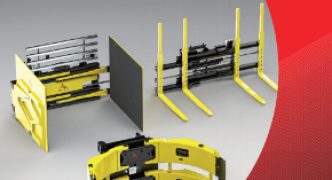
I. What Are Tire Handlers?
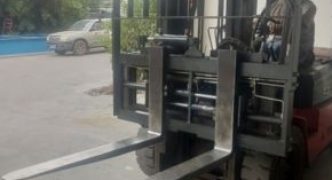
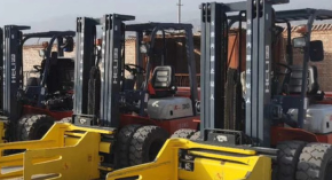
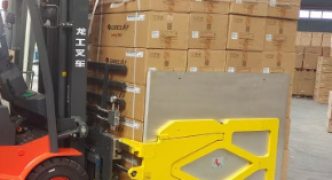
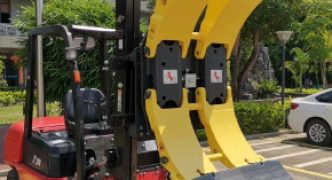
Tire handlers are specialized devices designed exclusively for the transportation, installation, and removal of tires and rims. They can be quickly adapted to various types of forklifts. Their core function is to achieve safe clamping and precise control of tires of different specifications and weights through hydraulically driven clamping plates, fork arms, or dedicated fixtures.
Our company, ANTWELL Forklift Truck Attachments Co. Ltd, offers a wide range of tire-handler attachments to meet customers’ application needs across diverse scenarios.
II. Structural Features of Tire Handlers
- High-Strength Construction: The all-steel frame and thickened fork arms, paired with specialized clamping plates, not only ensure load-bearing stability but also prevent tire damage.
- Hydraulic Drive Control: Equipped with high-quality hydraulic components, it enables smooth opening/closing of clamping plates and adjustable clamping force for precise and controllable operation.
- Durable Patterned Clamp Plates: The textured clamping plates are wear-resistant for an extended service life. Replaceable wear pads are installed on the back of the plates—when the pads are worn, users only need to replace the pads instead of the entire clamping plates.
- Safety Protection: The rounded edges of the fork arms facilitate insertion under tires and prevent damage to adjacent tires.
III. Main Application Scenarios of Tire Handlers
- Construction Machinery & Mining: Provides safe handling solutions for large tires used on construction vehicles and mining equipment.
- Logistics, Warehousing & Ports: Enables tire stacking, transfer, and storage management. Space utilization is optimized by flexibly adjusting tire placement angles.
- Specialized Industries: Covers the handling of aircraft tires, tire processing in high-temperature environments, as well as the loading and unloading needs of specialized tires for agricultural machinery and heavy-duty trucks.
IV. Classification and Features
ANTWELL offers a wide range of tire handlers to accommodate different tire types and operational requirements.
1.Tire Clamps
ANTWELL’s standard tire clamps adopt symmetric arc-shaped hydraulic clamping arms designed to match the natural curvature of tires. This ensures even force distribution across the contact surface, reducing the risk of deformation during handling.The clamping force is adjustable and remains stable throughout operation, making it suitable for handling multiple tires simultaneously while maintaining tire protection. The clamps can also be paired with ANTWELL’s Load Extender to extend the operating range.


2. F-series Tire Clamps
The F-series tire clamps feature flat, straight clamp arms. Compared with standard Tire Clamps, the F-series is especially suited for operations in narrow or confined spaces.Its simple structure keeps maintenance costs low and ensures strong versatility, making it ideal for bulk tire transfer in warehouses. Like the standard tire clamps, the F-series can also be combined with ANTWELL’s Load Extender.
3. T-series Tire Clamps
The T-series tire clamps feature full 360° rotation, reducing the need for frequent forklift steering and simplifying tire positioning. This makes them ideal for adjusting tire orientation and side stacking, significantly enhancing operational flexibility and efficiency.The compact clamp arms provide excellent maneuverability in tight spaces. The T-series tire clamps can be mounted not only on forklifts but also on telehandlers.


4. A-series Tire Clamps
The A-series tire clamps are designed for handling single, large tires, making them ideal for tire removal and installation. The robust movable arm structure allows multi-angle rotation, side-shifting, and forward-tilting movements. With a high load capacity of up to 16,000 kg or even more, the A-series is widely used in mining operations, facilitating efficient replacement and handling of large tires.
5. Tire Grippers
Tire grippers are specifically designed for the installation and removal of large tires on construction machinery. By opening and closing its three jaws, the gripper securely clamps tires lying flat on the ground. The three-jaw design allows precise handling even in tight spaces, while the 90° forward-tilting function facilitates picking up tires directly from the ground, ensuring safe and efficient tire handling.


6. Steel Wheel Clamps
Steel wheel clamps are designed for the safe and controlled forward tilting of steel wheels, and are particularly suitable for handling railway wheel hubs. With interchangeable attachments, they can also support the handling and tilting of various loads. Special bushings are used at the articulation points, offering significantly higher hardness than conventional bronze bushings and extending service life. The self-lubricating design reduces wear and helps prevent pin shaft damage caused by rapid bushing wear.
If you have any questions or would like further information about the tire handlers introduced above, please feel free to contact our sales team.
V. Core Advantages of Tire Handlers
- Asset Protection: The flexible clamping design minimizes tire scratches and impact damage, extending tire service life and warehouse turnover cycles.
- Versatile Adaptability: Compatible with tires of multiple specifications, it allows quick switching of operation modes to adapt to diverse scenarios such as warehousing and construction sites.
- Cost Optimization: Its robust and durable structure ensures a long service life with simple maintenance, reducing equipment replacement and upkeep costs.
- Mark-Free Operation Guarantee: Uses specialized non-slip and mark-free clamp pads to avoid leaving clamping marks on tire surfaces, ensuring the appearance quality of tires.
VI. Maintenance & Care Tips
- Cleaning & Hydraulic Maintenance: Remove impurities from clamp arms, clamp plates and hydraulic components after operation. Regularly check the hydraulic oil level and cleanliness.
- Wear Part Inspection & Replacement: Check clamp plate patterns, wear-resistant blocks and non-slip pads weekly. Replace them in a timely manner when the wear-resistant blocks or the non-slip pads are damaged.
- Storage Specifications: For long-term idle storage, keep the equipment in a dry and well-ventilated place, coat metal surfaces with anti-rust oil, and avoid exposure to rain and direct sunlight.